
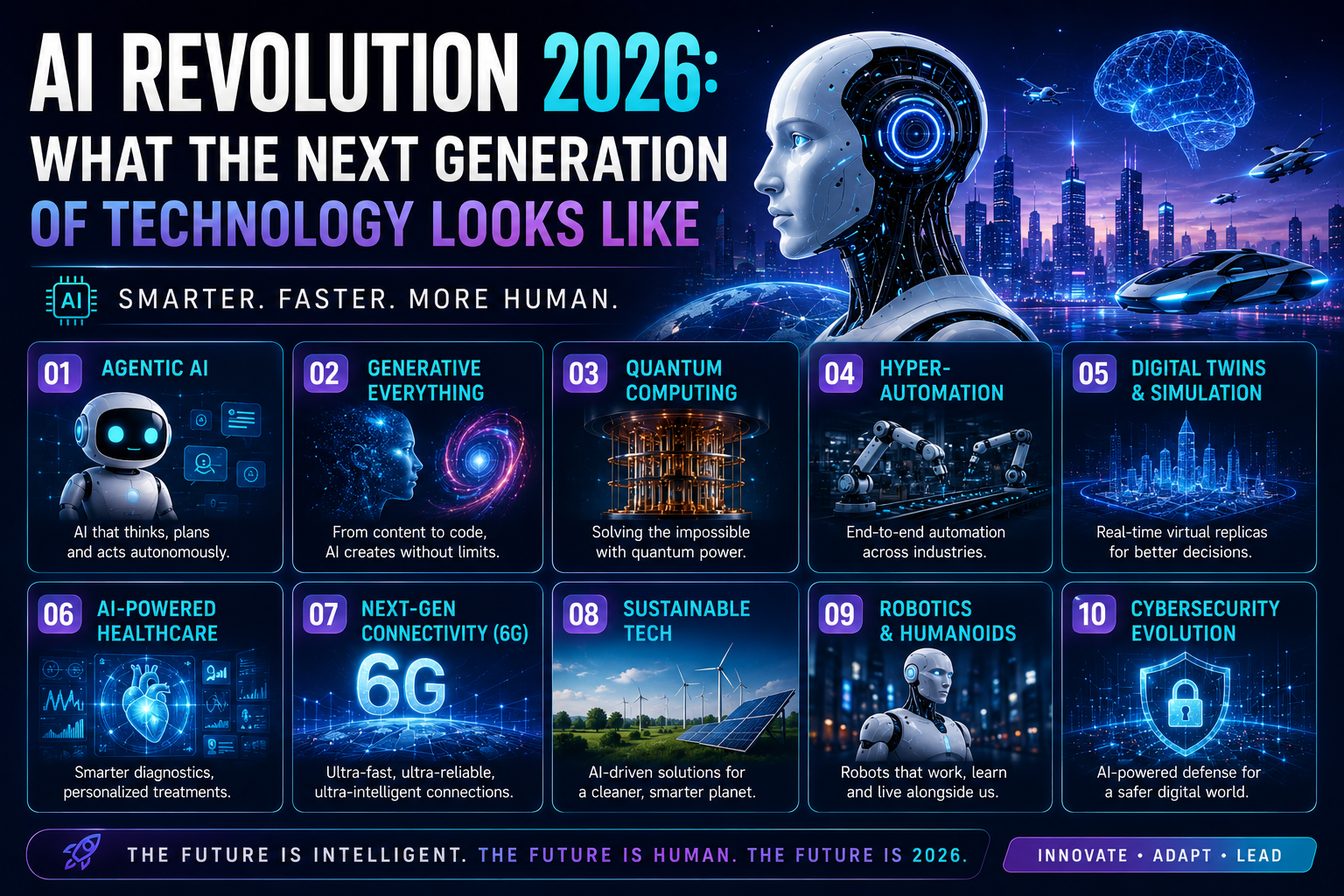
AI Revolution 2026: What the Next Generation of Technology Looks Like
The era of wide-eyed wonder surrounding artificial intelligence has officially come to a close. For the last few years, we lived through a massive wave of technological hype—characterized by flashy product demonstrations, speculative venture-capital pitches, and bold claims that AI would automate every human job by the weekend. Every company slapped an “AI-powered” label on their software, and text-generating chatbots became the hottest novelty on the internet.
But as we navigate through 2026, the tech industry has undergone a massive reality check. The novelty of typing a prompt into a text box and waiting for a static paragraph of text has completely worn off.
The next generation of technology isn’t about isolated digital toys trying to mimic human conversation. Instead, the AI revolution has moved into a practical, raw, and infrastructure-heavy phase. Today, AI operates as an underlying engine—quietly rewriting the rules of corporate productivity, digital privacy, and heavy industrial engineering.
If you want to look past the superficial headlines and understand what the next generation of the AI revolution actually looks like, here are the core pillars defining the landscape in 2026.
1. The Shift to Agentic AI (From Assistance to Autonomy)
Until recently, AI was entirely reactionary. It was a passive assistant: you asked a question, and it gave you an answer. If you wanted to complete a multi-step task, you had to act as the middleman—copying data from a chatbot, pasting it into a spreadsheet, formatting it, and uploading it to another system.
In 2026, the focus has completely flipped to Agentic AI—the deployment of autonomous AI agents. Instead of giving an agent step-by-step instructions on how to do something, you simply provide it with a high-level objective and the digital keys to your software tools.
For example, a modern business agent can be told: “Monitor our customer support inbox, identify the top three recurring product complaints this week, pull the relevant user data from our database, draft a bug report for the engineering team, and send a polite apology email with a discount coupon to the affected users.” The agent plans its own multi-step workflow, interacts with third-party applications, fixes its own errors mid-process, and executes the entire sequence. AI is no longer just a tool you use; it is an autonomous digital teammate.
2. The Rise of Edge AI and Data Sovereignty
For years, the intelligence of advanced AI models depended entirely on sending your data across the internet to massive, energy-hungry cloud data centers. This dynamic created constant bottlenecks regarding processing latency, required a permanent high-speed internet connection, and raised massive data privacy concerns for individuals and corporations alike.
The next generation of AI has successfully broken free from the cloud through Edge AI. Thanks to specialized Neural Processing Units (NPUs) engineered directly into modern smartphones, laptops, and local hardware architectures, complex AI reasoning now happens locally on your physical device.
You can process confidential financial records, edit high-definition video files, or translate languages in real-time completely offline. Because your private data never leaves your device, Edge AI offers unparalleled processing speeds and a massive victory for personal data privacy.
3. Inverse Design and Physical Engineering
We have all watched AI generate digital images and essays, but the most disruptive power of the current AI revolution is playing out in the physical world through a concept called Inverse Design (or generative engineering).
Historically, human engineers spent months or years manually drafting blueprints for complex machinery, aerospace components, or microchips—testing them in wind tunnels or simulation software, finding flaws, and starting the process over.
With Inverse Design, the engineering process is completely reversed. Engineers simply input their final performance metrics, material constraints, and budget limits into an AI system. The AI then runs millions of evolutionary simulations in seconds, generating radically optimized, organic-looking structures that a human designer would never have conceived. This technology is cutting manufacturing timelines in half and creating ultra-lightweight, hyper-efficient hardware across the aerospace and automotive industries.
4. Neuromorphic Computing (Solving the Energy Crisis)
As global AI models continue to expand exponentially, traditional silicon microchips are hitting a critical physical and environmental wall. Running massive AI data centers requires an unsustainable, eco-unfriendly amount of electricity and water for cooling systems.
To prevent a global energy crisis, the next generation of tech is executing a major architectural pivot toward Neuromorphic Computing. These are microchips deliberately engineered to mimic the physical wiring of the human biological brain.
Traditional computer chips waste an enormous amount of power by constantly moving data linearly back and forth between a separate memory unit and a processing unit. Neuromorphic chips integrate memory and processing together, firing electronic impulses only when a specific threshold is met—just like biological neurons. This allows complex AI algorithms to execute using a microscopic fraction of the energy required by standard server racks, making sustainable, widespread AI scale a reality.
5. Multimodal Humanoid Robotics
The AI revolution is no longer confined to digital screens. In 2026, advanced artificial intelligence has officially taken physical form through the deployment of multimodal humanoid robots across industrial supply chains.
Equipped with advanced visual-spatial AI brains, these modern humanoids don’t need to be hard-coded to follow rigid, pre-set paths. They can walk into an unfamiliar warehouse environment, visually map out the dynamics of the floor, and learn how to handle delicate, irregular, or fragile packages simply by observing a human worker do it once. As manufacturing and logistics sectors face severe global labor shortages, these adaptive machines are stepping in to handle high-risk, monotonous, and physically exhausting tasks, allowing human workers to shift into safe, supervisory roles.
The Reality-Driven Horizon
If there is one defining truth about the AI revolution in 2026, it is that technology is becoming invisible. The most successful innovations of this generation aren’t trying to pull you into a virtual world or force you to interact with gimmicky interfaces.
Instead, next-generation AI is working deeply and quietly in the background—protecting your digital identity through decentralized protocols, personalizing medical treatments down to your unique genetic code, optimizing local energy grids, and stripping away the mundane digital chores of daily life.
The future of technology isn’t a science-fiction movie about machines replacing humanity; it is a highly calculated, ultra-efficient upgrade to the physical and digital infrastructure we inhabit every single day. Staying informed on these foundational shifts ensures you remain ahead of the curve as the global landscape continues its quiet, unstoppable transformation.