
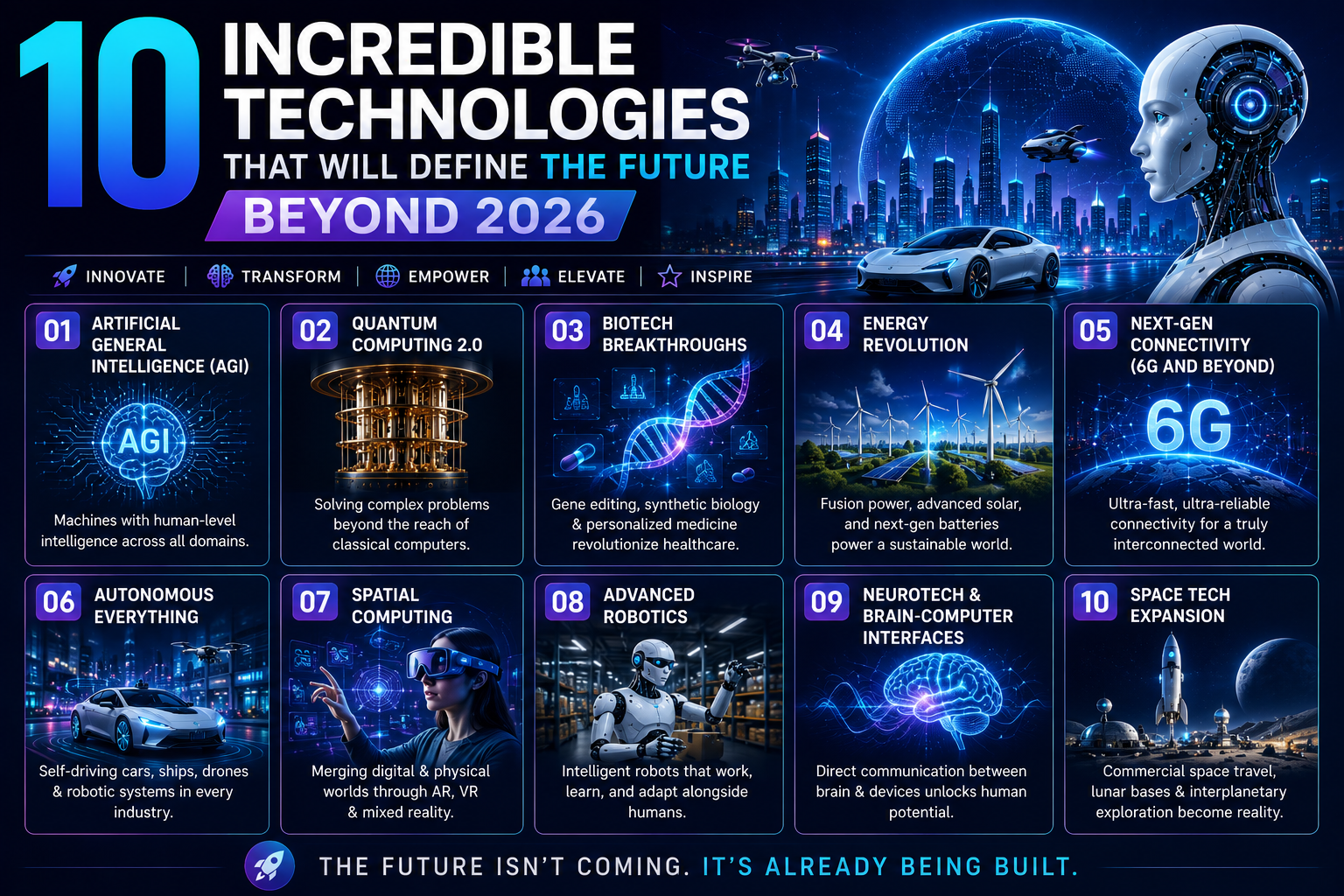
10 Incredible Technologies: That Will Define the Future Beyond 2026
The conversation around technology is undergoing a massive cultural shift. For years, we lived in an era dominated by immediate digital novelties—slapping an “AI” sticker on basic software, chasing virtual reality trends that isolated us from the real world, and tracking social media algorithms.
But as we look past the horizon of 2026, the global tech landscape is entering a far more mature, infrastructure-heavy, and high-impact phase. The defining innovations of the next decade aren’t gimmicky apps or flashy gadgets designed to capture venture capital. Instead, they are foundational, deep-tech systems engineered to rewrite the rules of human health, global security, environmental energy, and physical manufacturing.
If you want to look past the temporary marketing noise and understand the macro-trends shaping our long-term future, here are the 10 incredible technologies that will define the world beyond 2026.
1. Fully Autonomous Agentic Ecosystems
Artificial intelligence is outgrowing its role as a passive assistant. The next decade will not be defined by conversational chatbots waiting for you to type a prompt; it will be ruled by Agentic AI—networks of autonomous AI agents that operate as active digital executors.
Instead of a human acting as the middleman to coordinate different software tools, these next-generation agents will communicate with each other to manage entire corporate departments or personal workflows. You will simply give a high-level objective, such as: “Launch a local e-commerce store for our new product line, optimize the supply chain logistics, set up the customer service triggers, and manage the digital ad spend based on real-time ROI.” The agents will divide the tasks, interact with third-party APIs, troubleshoot their own technical errors, and execute the entire project from scratch.
2. Post-Quantum Cryptography (PQC) Networks
While full-scale commercial quantum computers are still heavily guarded laboratory systems, their theoretical ability to crack modern encryption has triggered an unprecedented, preemptive global security migration. Standard encryption protocols (like RSA) protect everything from global banking infrastructure to military communications, and a mature quantum machine could dismantle them instantly.
To prevent a future global security collapse, the tech landscape beyond 2026 will be defined by the universal deployment of Post-Quantum Cryptography (PQC). Financial institutions, cloud providers, and sovereign defense networks are systematically re-engineering their digital vaults using incredibly complex mathematical equations that even the most powerful quantum computer cannot break. It is a silent, invisible cybersecurity revolution that will ensure data integrity for generations to come.
3. Smart Spaces and Invisible Spatial Computing
The concept of wearing heavy, clunky plastic headsets to escape into a virtual reality has largely been left behind. The true future of immersive technology belongs to Spatial Computing integrated into our physical environments.
The next decade will see the commercial maturity of advanced light-field displays, smart surfaces, and micro-projectors that seamlessly layer digital data onto the physical world with perfect depth perception. Instead of staring down at a smartphone or checking monitor screens, digital interfaces, architectural blueprints, and communication channels will be projected into your real-world workspace. From mechanics viewing real-time engineering diagnostics overlaid directly onto a physical engine to interactive smart homes that adapt to your non-verbal cues, spatial computing is making technology invisible and ambient.
4. Fully On-Device Edge intelligence
The initial phase of the AI boom required massive, energy-guzzling cloud data centers, meaning every piece of user data had to be uploaded across the internet and sent back. This created permanent challenges regarding processing latency, required robust internet access, and introduced significant corporate and personal data leaks.
The future beyond 2026 belongs to Edge AI. Driven by specialized, ultra-efficient Neural Processing Units (NPUs) built directly into everyday local hardware—from smartphones and laptops to industrial sensors and automobiles—complex machine reasoning will happen locally. Your private files, real-time translations, and automated tasks will process entirely offline without ever leaving your physical device. This shift represents a massive victory for data sovereignty, zero-latency processing, and localized digital security.
5. Multimodal Humanoid Robots in the General Economy
Advanced artificial intelligence has officially broken out of digital screens and taken physical form. Driven by severe global labor shortages and the need for safer workplace conditions, multimodal humanoid robots are moving out of trial factories and into the broader physical economy.
Equipped with sophisticated computer vision and adaptive AI brains, these machines don’t rely on rigid, hard-coded software tracks. They can step into an unfamiliar warehouse, visually evaluate the spatial layout, learn how to sort or transport irregular, fragile objects simply by watching a human worker do it once, and safely collaborate with humans. They are stepping in to handle high-risk, monotonous, and heavy physical labor, allowing human workforces to elevate into safer, supervisory execution roles.
6. Inverse Design and AI-Driven Physical Engineering
We have watched generative technology create digital art and text, but its most revolutionary industrial application is a concept known as Inverse Design (or generative engineering).
Historically, human engineers spent months or years manually drafting blueprints for machinery, aircraft parts, or microchips—testing them in physical simulators, discovering flaws, and restarting the design process. With Inverse Design, that workflow is completely inverted. Engineers input their final performance metrics, material constraints, and target budgets into an AI system. The AI then simulates millions of evolutionary physical iterations in seconds, generating radically optimized, organic-looking structures that human minds would never have conceived. This is fundamentally altering construction, aerospace engineering, and semiconductor design.
7. Programmable Medicine and Synthetic Biology
The intersection of advanced computer models and molecular biology has transformed healthcare from a reactive guessing game into an exact, programmable science. The future of medicine will move completely away from mass-manufactured chemical drugs that cause widespread systemic side effects.
By training generative AI networks on millions of complex protein structures, scientists can now design entirely custom synthetic molecules tailored to target cellular anomalies down to an individual patient’s unique genetic code. Whether it is engineering smart enzymes that neutralize cancerous tumors without damaging nearby healthy tissue or designing highly specific antiviral proteins on demand, programmable medicine will dramatically extend human healthspan and change how we treat chronic diseases.
8. Commercial Solid-State and Silicon-Anode Energy Storage
The global transition toward green energy grids, automated infrastructure, and long-range electric vehicles has been severely bottlenecked by the physical limitations of traditional Lithium-ion battery chemistry, which suffers from energy density ceilings and slow charging speeds.
The next decade will be supercharged by the widespread commercial scale of silicon-anode and solid-state batteries. By replacing standard graphite components with engineered silicon or solid electrolyte layers, new-age batteries can hold exponentially more power within the exact same physical footprint. This technology will permanently erase range anxiety for electric vehicles, cut industrial charging times down to minutes, and provide the stable, high-capacity storage needed to run regional electrical grids on 100% renewable energy.
9. Cryptographic Decentralized Identity (DID) Protocols
As the internet becomes flooded with hyper-realistic deepfakes, automated phishing operations, and massive corporate database leaks, traditional identity systems—like usernames, passwords, and centralized single sign-ons—are no longer safe. The digital world is experiencing a profound trust crisis.
The long-term solution gaining massive systemic traction is Decentralized Identity (DID). Instead of allowing tech conglomerates or centralized databases to hold, track, and monetize your personal verification data (like your passport details, credit history, or biometric data), DID hands full data ownership back to the individual. You hold your credentials in a secure digital wallet. When a service provider needs to verify your identity, you share a secure, cryptographically signed proof without ever revealing the underlying raw data itself.
10. Neuromorphic Microchip Architecture
As global digital networks and AI computational demands expand exponentially, traditional silicon microchips are hitting a critical physical and environmental wall. Running traditional data centers requires an unsustainable, ecologically unfriendly amount of electricity and water for cooling systems.
To make global scaling sustainable, the tech industry is executing a major architectural pivot toward Neuromorphic Computing. These are microchips engineered to mirror the physical wiring and operational efficiency of the human biological brain. Traditional chips waste a massive amount of power by constantly shuttling data back and forth between separate memory units and processing units. Neuromorphic chips integrate memory and processing together, firing electronic impulses only when a specific threshold is met—just like biological neurons. This allows complex automated workloads to execute using a microscopic fraction of the energy required by standard server racks.
The Reality-Driven Horizon
If there is one absolute truth defining the long-term future of technology, it is that innovation is becoming integrated rather than isolated. The era of standalone gadgets trying to distract us from reality is coming to an end.
The technologies defining the next decade are working deeply and quietly behind the scenes—safeguarding our digital identities, optimizing our clean energy grids, designing ultra-efficient physical hardware, and personalizing our healthcare down to the cellular level.
The future is not about escaping into a science-fiction illusion; it is about building a highly calculated, ultra-resilient, and hyper-efficient infrastructure to dramatically upgrade the physical and digital world we inhabit every single day. Staying informed on these ten structural pillars ensures you remain miles ahead as the global landscape continues its quiet, unstoppable evolution.