
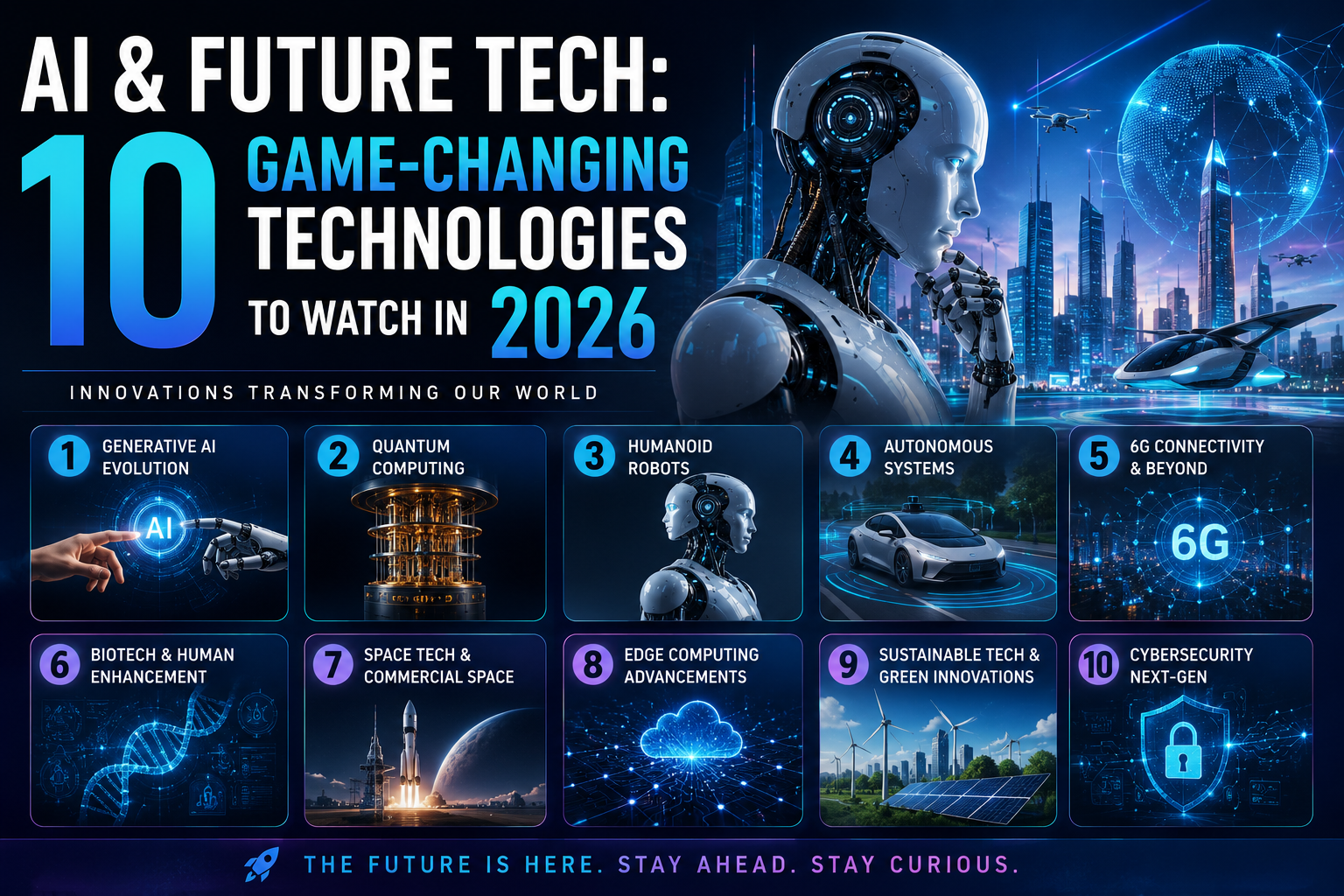
AI & Future Tech: 10 Game-Changing Technologies to Watch in 2026
We have officially moved past the era of tech hype. For the last few years, the world lived through a massive wave of technological promises—artificial intelligence was going to replace everything overnight, quantum computing was just around the corner, and the metaverse was supposed to change how we work. Some of it felt revolutionary, while much of it felt like marketing noise designed to chase venture capital.
But as we navigate through 2026, the dust has finally settled. The tech industry has undergone a massive reality check, moving away from flashy proof-of-concepts to practical, raw, and infrastructure-heavy deployments. The technologies defining this year aren’t just cool laboratory experiments; they are deeply integrated tools rewriting the rules of global economies, personal privacy, and daily human life.
If you want to look past the superficial headlines and understand where the world is actually moving, here are the 10 game-changing technologies you need to watch in 2026.
1. Autonomous AI Agents (Beyond the Chatbot)
The era of typing prompts into a text box and waiting for a static answer is rapidly fading. In 2026, the focus has completely shifted from conversational AI to Agentic AI. These are autonomous AI agents capable of executing complex, multi-step workflows with minimal human intervention.
Instead of you manually booking flights, coordinating calendars, and cross-checking data across three spreadsheets, an AI Agent acts as an active digital executive. You give it a high-level goal—“Analyze our Q1 sales drop, coordinate a sync meeting with the regional managers, and draft a recovery strategy slide deck”—and the agent executes the entire sequence. They can interact with third-party software, make real-time decisions, and fix their own errors mid-process. We are moving from AI as a smart assistant to AI as a functional teammate.
2. Edge AI and On-Device Processing
For years, the power of advanced AI models depended entirely on massive, energy-hungry cloud data centers. This created severe bottlenecks regarding latency, data privacy, and internet dependency. In 2026, the paradigm has flipped toward Edge AI.
Thanks to specialized Neural Processing Units (NPUs) engineered directly into modern smartphones, laptops, and IoT devices, complex AI models can now run locally without uploading your private data to a distant cloud server. This means real-time language translation, advanced video editing, and complex automated reasoning happen instantly on your device, even when you are completely offline. It’s a massive win for data sovereignty and operational speed.
3. Spatial Computing and Light-Field Displays
The dream of clunky Virtual Reality (VR) headsets taking over our lives has evolved into something far more elegant: Spatial Computing. The technology has matured beyond gaming and virtual meeting rooms into a seamless layer blended on top of our physical world.
The breakthrough in 2026 revolves around advanced light-field displays and lightweight smart glasses that don’t isolate you from reality. Instead, they anchor digital interfaces, design schematics, and interactive data directly into your physical workspace with perfect depth perception. From surgeons mapping out complex procedures in mid-air to mechanics viewing real-time engine diagnostics overlaid on physical hardware, spatial computing is changing how humans interact with digital information.
4. Advanced Humanoid Robotics
Humanoid robots have transitioned from viral laboratory videos to actual factory floors and logistics hubs. We aren’t quite at the stage of having robots wash our dishes at home, but industrial supply chains are experiencing a massive automation rewrite.
Equipped with multimodal AI brains, these modern humanoids don’t need to be hard-coded with repetitive tracks. They can look at an unfamiliar warehouse environment, understand spatial dynamics, learn tasks simply by observing human workers, and handle delicate or irregular objects with remarkable dexterity. As manufacturing sectors face global labor shortages, these adaptive machines are stepping in to handle high-risk, monotonous tasks.
5. Synthetic Biology and Programmable Medicine
The intersection of AI and biology has yielded one of the most miraculous technological shifts of this decade. Medicine is moving away from generalized chemical treatments toward highly personalized, programmable biology.
Using generative AI models trained on millions of protein structures, scientists can now design synthetic molecules optimized to target specific diseases down to an individual’s unique genetic profile. Instead of treating symptoms with broad antibiotics or invasive therapies, 2026 is seeing the rise of customized, bio-printed treatments engineered to fix cellular anomalies with absolute pinpoint precision. We are essentially learning how to write code for human biology.
6. Post-Quantum Cryptography (PQC)
While commercial quantum computers capable of breaking the internet are still a work in progress, the security threat they pose has created a massive preemptive technology wave. Traditional encryption standards like RSA are highly vulnerable to future quantum attacks.
In response, 2026 has marked a critical turning point for the deployment of Post-Quantum Cryptography (PQC). Governments, financial institutions, and global tech giants are aggressively migrating their entire security infrastructure to quantum-resistant mathematical algorithms. It is a silent, invisible cybersecurity overhaul happening behind the scenes to ensure that global data caches remain secure against the next generation of computing power.
7. Generative AI for Physical Engineering (Inverse Design)
We’ve all seen AI generate images and essays, but the true disruptive power of generative tech is currently playing out in heavy industry through a concept called Inverse Design.
Engineers no longer need to spend months manually drafting blueprints for airplane wings, car chassis, or microchips. Instead, they input performance parameters into an AI system—such as weight limits, aerodynamic drag targets, and material constraints. The AI then simulates millions of iterations to generate radically optimized, organic, and ultra-efficient structures that human designers would never have dreamed of. This is radically accelerating production timelines across aerospace and automotive industries.
8. Silicon-Anode and Solid-State Batteries
The green energy transition has long been bottlenecked by the limitations of traditional Lithium-ion battery chemistry, which suffers from slow charging speeds and energy density ceilings.
In 2026, the commercial scaling of silicon-anode and semi-solid-state batteries is breaking that bottleneck. By replacing graphite anodes with silicon structures, new-age batteries can hold significantly more energy and charge from 0% to 80% in a fraction of the time. This technology is quietly transforming the electric vehicle (EV) market, eliminating range anxiety, and paving the way for more efficient grid-level renewable energy storage.
9. Decentralized Identity (DID) and Sovereign Data
As deepfakes become virtually indistinguishable from reality and online identity theft hits an all-time high, traditional passwords and centralized database verifications are no longer sufficient. The internet is undergoing a major identity crisis.
The solution gaining massive traction this year is Decentralized Identity (DID) protocols. Instead of letting tech conglomerates hold and monetize your personal verification data (like your passport, birth certificate, or banking history), DID uses cryptographic ledgers to let you own your identity. You hold your credentials in a secure digital wallet and share only verified proofs—not the raw data itself—with third parties. It’s a systemic push to return data ownership to the individual.
10. Neuromorphic Computing Chips
As AI models continue to grow exponentially, standard silicon microchips are hitting a thermal and electrical wall. Running massive AI algorithms requires an unsustainable amount of electricity. Enter Neuromorphic Computing.
These are microchips engineered to mimic the physical architecture of the human brain. Traditional chips process data linearly between a separate memory and processing unit, which wastes a massive amount of energy. Neuromorphic chips integrate processing and memory together, firing electronic impulses only when needed—just like human neurons. This allows them to process highly complex AI tasks using a microscopic fraction of the power required by traditional server racks, making sustainable, planet-friendly global AI scale a reality.
The Reality-Driven Future
The defining theme of technology in 2026 is integration over isolation. The industry has stopped building isolated toys and has started building interconnected infrastructure.
The most successful innovations of this year aren’t trying to pull humans away from reality into a digital illusion. Instead, they are working quietly in the background—optimizing our energy grids, protecting our digital data, accelerating medical breakthroughs, and freeing up our cognitive space from mundane digital chores.
The future isn’t a sci-fi movie; it’s a highly calculated, ultra-efficient upgrade to the world we already live in. Keeping an eye on these ten pillars will ensure you remain ahead of the curve as the global landscape continues its quiet, unstoppable transformation.