
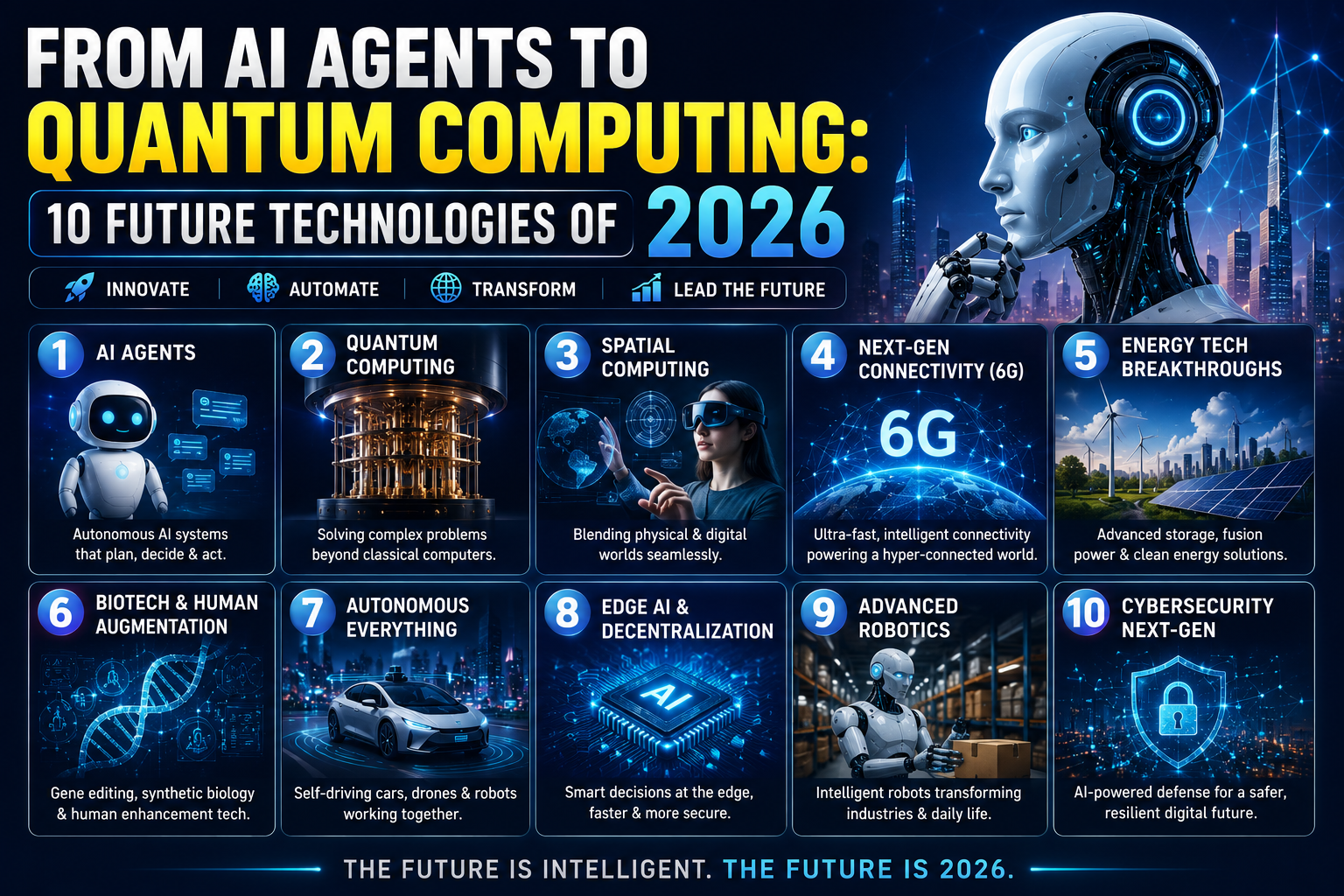
From AI Agents to Quantum Computing: 10 Future Technologies of 2026
We have officially moved past the era of pure tech speculation. For the last few years, the digital space lived through a massive wave of technological hype—artificial intelligence was going to replace every white-collar job overnight, quantum computing was going to crack global security by Tuesday, and we were all supposed to be sitting in virtual boardrooms wearing heavy headsets.
As we navigate through 2026, the tech industry has undergone a massive reality check. The focus has completely shifted from flashy venture-capital pitches to raw infrastructure, practical execution, and tools that quietly solve real-world problems.
If you want to look past the superficial marketing noise and understand where the digital and physical architecture of our world is actually moving, here are the 10 game-changing future technologies defining 2026.
1. Agentic AI (The Rise of Autonomous AI Agents)
The novelty of typing a prompt into a text box, waiting for a paragraph of text, and manually copying it over to another application has completely worn off. In 2026, conversational chatbots have evolved into Autonomous AI Agents.
Instead of acting as passive answer-generators, Agentic AI acts as an active digital executor. You no longer give it instructions on how to do a task; you simply give it a high-level objective. For example, you can tell an agent: “Audit our website’s broken internal links, cross-check them with our updated sitemap, fix the redirects in the backend, and email a summary report to the web master.” The agent creates its own multi-step workflow, interacts with third-party software applications, troubleshoots its own errors, and delivers the final result. We are moving from AI as a tool to AI as an autonomous digital teammate.
2. Post-Quantum Cryptography (PQC)
While full-scale commercial quantum computers are still carefully guarded laboratory giants, the security threat they pose has triggered a massive, preemptive global security overhaul this year. Standard encryption methods like RSA—which protect everything from your online banking to government databases—can theoretically be shattered instantly by a mature quantum machine.
To prevent a catastrophic future data breach, 2026 has marked the aggressive, widespread deployment of Post-Quantum Cryptography (PQC). Financial institutions, global tech conglomerates, and defense networks are systematically rewriting their entire security layers using complex mathematical algorithms that even the most powerful quantum computer cannot crack. It is a silent, invisible cybersecurity revolution ensuring that data cached today remains completely safe tomorrow.
3. Spatial Computing and Light-Field Workspaces
The clunky, isolating Virtual Reality (VR) headsets that promised to trap us in digital worlds have largely been abandoned. Instead, the technology has evolved into something far more elegant and practical: Spatial Computing.
The breakthrough in 2026 revolves around advanced light-field displays and lightweight, unobtrusive smart glasses. Rather than cutting you off from your physical surroundings, these devices anchor high-definition digital interfaces, interactive data streams, and 3D design schematics directly onto your real-world desk or workspace with perfect depth perception. From software engineers arranging infinite floating monitors around their room to interior designers walking clients through fully rendered architectural overhauls inside an empty brick shell, spatial computing has seamlessly blended our digital and physical realities.
4. Edge AI and On-Device Processing
For a long time, running any advanced AI model required a massive amount of computing power, meaning your data had to be sent to a distant, energy-hungry cloud server and sent back. This process created constant issues with latency, internet dependency, and data privacy.
In 2026, the paradigm has completely flipped to Edge AI. Thanks to incredibly efficient Neural Processing Units (NPUs) built directly into modern smartphones, laptops, and local hardware, complex AI reasoning now happens locally on your device. You can translate languages in real-time, generate code, or process secure files completely offline. Your private data never leaves your physical device, making AI faster, more reliable, and significantly more secure.
5. Advanced Humanoid Robotics in Supply Chains
Humanoid robots are no longer just the stars of viral laboratory videos or tech expos. In 2026, they have entered the real economy, deploying aggressively across manufacturing hubs, fulfillment centers, and industrial supply chains to handle severe global labor shortages.
Equipped with multimodal AI brains, these modern humanoids don’t need to be hard-coded to follow rigid, pre-set paths. They can walk into an unfamiliar warehouse, visually map out the layout, learn how to handle irregular or fragile packages simply by watching a human do it once, and operate safely alongside human workers. They are stepping in to handle high-risk, repetitive, and physically exhausting tasks, allowing human workers to shift into supervisory roles.
6. Inverse Design via Generative Engineering
We are all familiar with AI creating art and essays, but the true industrial disruption of generative technology in 2026 is a concept known as Inverse Design.
Historically, engineers spent months or years manually drafting blueprints for complex machinery, microchips, or aerodynamic structures, testing them, and starting over when they failed. With Inverse Design, the process is completely reversed. Engineers simply input their final performance targets into an AI system—such as weight limits, stress tolerances, and material costs. The AI then runs millions of simulated iterations in seconds to generate radically optimized, organic, and ultra-efficient physical designs that a human mind would never have conceived. This is cutting production timelines across the aerospace, automotive, and semiconductor industries in half.
7. Synthetic Biology and Programmable Medicine
The intersection of generative AI models and molecular biology has turned medicine into a field of programmable code. Instead of relying on generalized chemical treatments that come with a long list of systemic side effects, 2026 is witnessing the rise of highly personalized, synthetic biology.
By using advanced AI models trained on millions of protein structures, scientists can now design entirely custom synthetic molecules engineered to target cellular anomalies down to a single patient’s unique genetic code. Whether it is engineering smart enzymes that attack localized cancer cells without harming healthy tissue or designing highly specific antiviral proteins on demand, medicine is transitioning from a reactive guessing game into an exact, programmable science.
8. Silicon-Anode and Solid-State Energy Storage
The global transition toward green energy and electric vehicles has long been bottlenecked by the physical limits of traditional Lithium-ion batteries, which suffer from slow charging times and rigid capacity ceilings.
In 2026, the commercial scaling of silicon-anode and semi-solid-state batteries is breaking that bottleneck wide open. By replacing standard graphite components with engineered silicon structures, modern batteries can hold significantly more power within the same physical footprint. This technology has effectively eliminated range anxiety for electric vehicles, cut charging times down to mere minutes, and provided the stable, high-capacity infrastructure needed to store grid-level renewable energy efficiently.
9. Decentralized Identity (DID) Protocols
With the internet currently flooded by hyper-realistic deepfakes, sophisticated phishing scams, and massive corporate data breaches, traditional usernames, passwords, and centralized verification systems are no longer viable defenses. The digital world is facing a massive identity crisis.
The solution gaining massive mainstream adoption this year is Decentralized Identity (DID). Instead of allowing tech conglomerates to hold, manage, and inevitably monetize your personal verification data (like your passport details, banking history, or biometric data), DID hands control back to the individual. You hold your credentials in a secure, cryptographically signed digital wallet. When a service needs to verify your age, nationality, or credit score, you share a secure, verifiable proof without ever handing over the actual raw data.
10. Neuromorphic Computing Architecture
As global AI models continue to expand exponentially, traditional silicon microchips are hitting a critical thermal and environmental wall. Running massive data centers requires an unsustainable amount of electricity and water for cooling.
To solve this crisis, 2026 is seeing a major architectural pivot toward Neuromorphic Computing. These are microchips deliberately engineered to mimic the physical wiring of the human brain. Traditional chips constantly waste energy by moving data linearly back and forth between separate memory and processing units. Neuromorphic chips integrate memory and processing together, firing electrical impulses only when a specific threshold is met—just like biological neurons. This allows complex AI algorithms to run using a microscopic fraction of the power, making sustainable global digital scaling possible.
The Realistic Horizon
If there is one defining truth about technology in 2026, it is that the era of isolated gadgets is over. The most successful innovations of this year aren’t trying to pull you into a science-fiction movie or force you to live in a digital illusion.
Instead, they are working quietly and deeply in the background—securing your private data, optimizing the energy grids, accelerating medical breakthroughs, and stripping away the mundane digital chores of daily life. The future isn’t about escaping reality; it is about deploying highly calculated, ultra-efficient infrastructure to upgrade the world we already inhabit. Keeping an eye on these ten pillars will ensure you remain steps ahead as the global technological landscape continues its quiet, unstoppable evolution.