
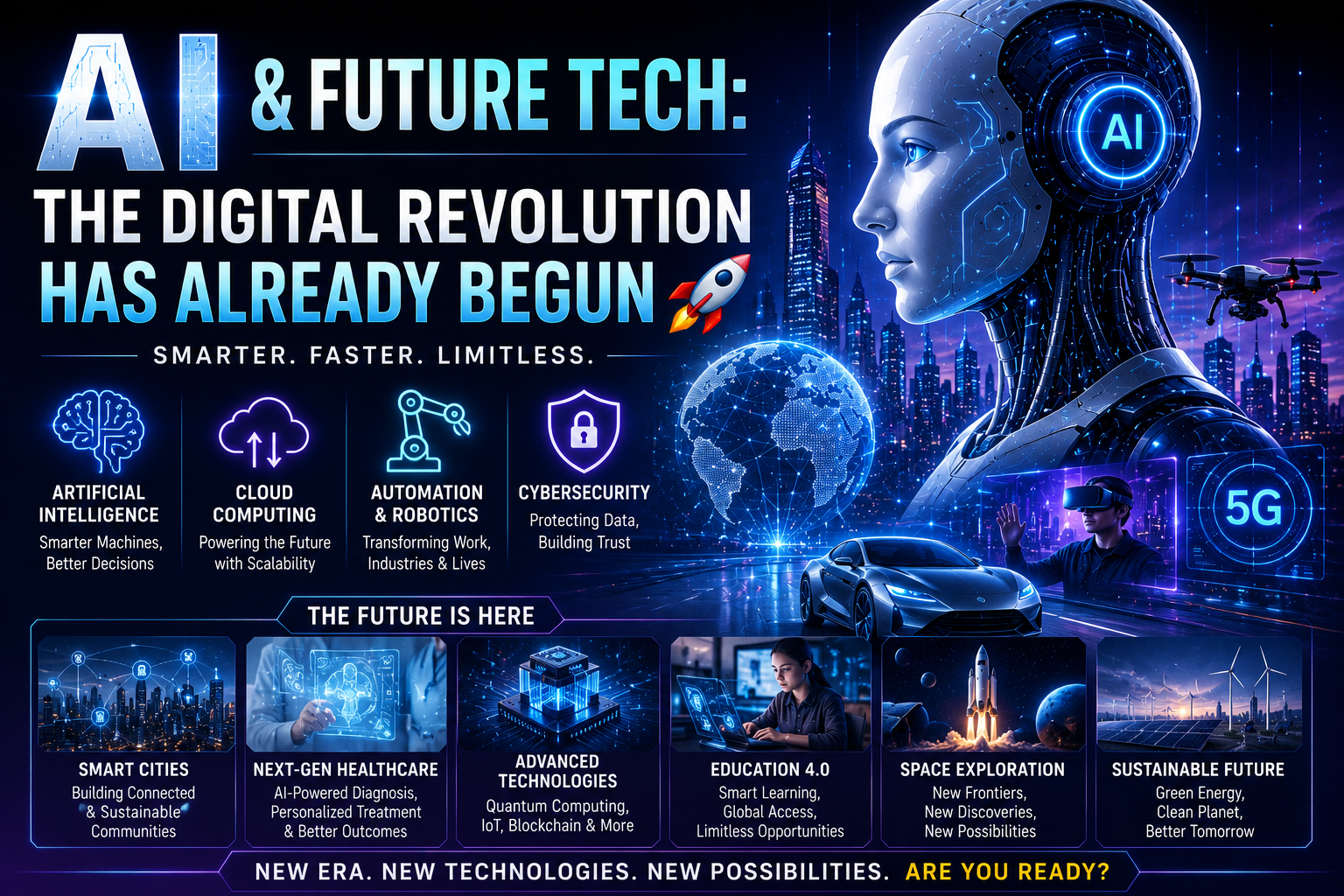
The line dividing the present from the future has officially faded. We are no longer waiting for a distant digital shift; the technological revolution is actively reshaping our daily lives, transforming static code into intelligent, lifelike systems that think, learn, and act autonomously.
Here is how the next wave of innovation is upgrading our world right now.
The Next Era: Active Execution (Agentic AI)
For years, interacting with artificial intelligence meant typing a question into a search engine or chatbox and reading through long pages of text. While helpful, it still left all the work on your shoulders. Today, that entire ecosystem is shifting from advice to execution.
Instead of a digital notebook, you now have access to an AI Agent. If you give it a complex goal—like managing a cross-platform project, organizing an event, or updating complex web code—the agent doesn’t just tell you how to do it. It connects to the necessary digital tools, communicates across platforms, and completes the entire process for you behind the scenes.
4 Emerging Breakthroughs Changing Reality
This rapid change isn’t just about software; it’s being driven by massive leaps across physical hardware, spatial networks, and infrastructure.
1. Spatial & Immersive Experiences
The era of staring down at flat glass screens is coming to an end. Through advanced virtual headsets and 3D holographic projections, data is entering our physical space. Whether it is a student walking through an immersive, lifelike simulation of a historic event or a team of creators mapping out a visual layout in real space, learning and design have become deeply experiential.
2. Native On-Device Intelligence (Edge AI)
Heavy reliance on giant, centralized cloud networks and continuous internet connections is shifting to localized hardware. Modern devices are now built with highly advanced, compact processors capable of running complex algorithms right in your pocket. This ensures lightning-fast execution speeds, absolute data privacy, and full access to smart tools even when completely offline.
AI & Future Tech: The Digital Revolution Has Already Begun 🚀
3. Humanoid Robotics
Robots are stepping out of heavily guarded factory cages and moving into environments built for humans. Equipped with real-time balance systems and spatial vision, humanoid assistants are training to handle highly repetitive, exhausting, or dangerous physical labor in logistics, healthcare, and domestic management—freeing up human time for creative oversight.
4. Space-Based Computing Networks
As global data demands grow exponentially, building massive data centers on Earth presents serious land and energy challenges. The cutting-edge solution? Moving data storage and processing into orbit. The natural freezing vacuum of outer space offers a built-in, cost-free cooling loop, while solar-harvesting networks capture pure cosmic energy, keeping our global digital footprints clean and sustainable.
Today vs. Tomorrow: The Modern Upgrade 📊
| The Old Way 🛑 | The Intelligent Way 🎉 | The Direct Benefit |
| Manual Application Flipping: Shuffling through multiple separate apps to manually coordinate schedules, type documents, and manage files. | Autonomous AI Agents: Issuing a single high-level command to trigger synchronized, cross-platform workflows. | Massive digital freedom; repetitive administrative chores are entirely handled for you. |
| Static Learning: Reading long blocks of printed text or analyzing flat 2D graphics to understand complex concepts. | Immersive Holograms & VR: Stepping directly inside 3D spatial environments to interact with data live. | Complex subjects become completely interactive, heavily boosting memory retention. |
| Cloud Dependency: Needing a steady, powerful Wi-Fi or cellular connection to run smart applications. | On-Device Edge Processing: Running high-level algorithmic brain models natively on local hardware. | Instantaneous system responses and entirely secured, private data loops. |