
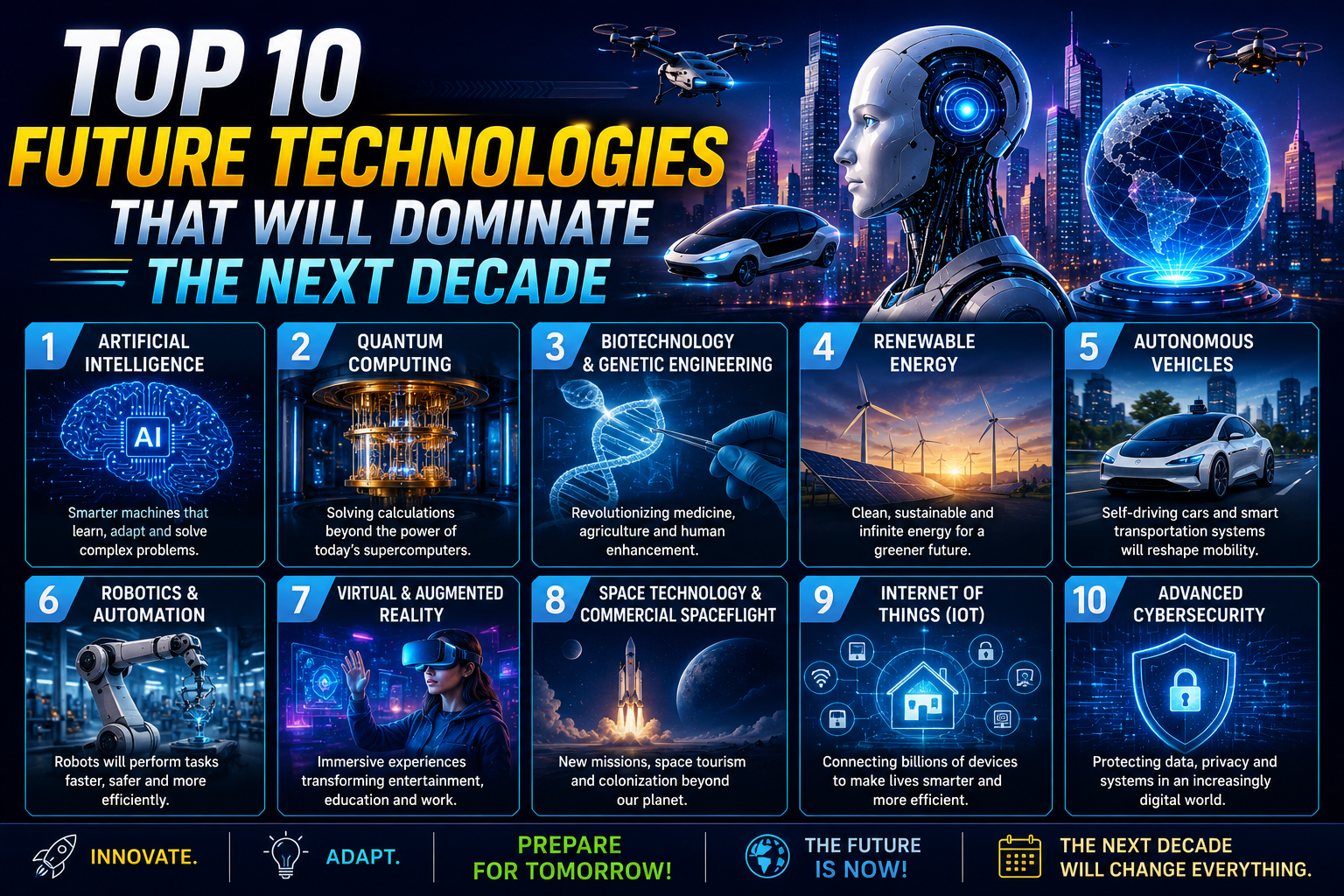
The next ten years will not just be an upgrade of the technology we use today; it will be a complete reimagining of how humans interact with the digital and physical worlds. We are moving away from passive screens and static software into an era of autonomous action, immersive realities, and planetary-scale engineering.
Here are the top 10 future technologies set to dominate the next decade.
1. Agentic AI (AI Agents) 🤖
While the early 2020s were dominated by generative AI that answered questions with text or images, the next decade belongs to AI Agents. These are autonomous digital systems designed for execution, not just advice. Instead of providing you with a flight itinerary, an AI Agent will securely connect to APIs, compare options against your budget, utilize your authorized payment methods, and execute the entire booking process end-to-end without human intervention.
2. Humanoid Robotics 🏃♂️
Robotics is rapidly moving past rigid industrial arms into dynamic, humanoid forms. Equipped with advanced spatial awareness, balance algorithms, and computer vision, these bipedal robots are designed to step directly into environments built for humans. They will increasingly take over high-risk, highly repetitive physical tasks in logistics, manufacturing, healthcare, and eventually, domestic help.
3. Spatial Computing & Holographic Media 👓
The boundary between our physical space and digital data is dissolving. Through advanced Virtual Reality (VR), Augmented Reality (AR), and interactive 3D holograms, static screens are being replaced by spatial environments. Whether it is a medical student standing inside a life-sized 3D simulation of a human heart or engineers collaborating on a virtual engine core, learning and working are becoming deeply experiential.
4. Quantum Computing 🧠⚡
Traditional computers process information using bits (0s and 1s), but quantum computing leverages the principles of quantum mechanics to evaluate millions of possibilities simultaneously. Over the next decade, quantum systems will solve complex mathematical riddles that would take classical supercomputers thousands of years to crack—accelerating molecular discovery, mapping deep-ocean topographies, and unlocking new climate change solutions.
5. Edge AI (On-Device Intelligence) 📱
To reduce latency and increase data security, the massive computational power of AI is shifting from centralized cloud servers directly onto local hardware. Edge AI integrates advanced neural processing units (NPUs) directly into consumer smartphones, smart vehicles, and wearables. This allows devices to execute highly complex, private algorithmic workflows instantaneously, even when completely cut off from an internet or Wi-Fi connection.
6. Space-Based Cloud Infrastructure 🌌
As data storage and AI model training expand exponentially, terrestrial data centers face severe spatial, energy, and cooling constraints. The next frontier is launching automated data centers into Earth’s orbit. The natural freezing vacuum of outer space eliminates the need for expensive cooling systems, while satellite solar arrays harvest unhindered cosmic energy, providing a clean, sustainable footprint for global networks.
7. Smart City Mesh Networks 🏙️
Tomorrow’s urban centers will operate as unified, self-optimizing ecosystems driven by integrated sensor arrays and centralized AI brains. Traffic management will shift from rigid timers to real-time, camera-monitored tracking that prioritizes public transit dynamically. Even waste management will become autonomous, with smart infrastructure signaling collection networks only when structural capacities are reached, heavily reducing municipal carbon footprints.
8. Precision Medicine & AI Genomics 🩺
Healthcare is shifting from generalized treatments to hyper-personalized, preventative cures. AI algorithms can now analyze a patient’s entire genetic makeup in seconds to predict potential illnesses long before symptoms manifest. Furthermore, AI-driven molecular modeling is shrinking the timeline required to discover and test life-saving drugs from decades down to a matter of weeks.
9. Autonomous Drone Logistics 🛸
The airspace of major cities is being transformed into structured transport corridors for unmanned aerial vehicles (UAVs). Driven by localized collision-avoidance AI, smart delivery drones are transitioning from novelty trial runs to standard infrastructural logistics—handling the rapid transport of emergency medical supplies, e-commerce goods, and perishable food directly to localized drop points.
10. Intelligent Smart Fabrics (Wearable Tech) 👕
The next generation of wearables will extend far beyond smartwatches. Microscopic, flexible conductive fibers are being woven directly into everyday clothing textiles. These smart fabrics can continuously monitor vital health metrics, dynamically adjust structural insulation based on ambient external temperatures, and even alter visual patterns or colors via smartphone commands.
The Paradigm Shift at a Glance 📊
| Legacy Framework | Next-Gen Framework | Core Strategic Advantage |
| Generative Assistance: Typing questions into a prompt box to receive static data. | Agentic Automation: Handing over a high-level goal to an AI Agent for full execution. | Eliminates digital friction and administrative overhead. |
| Terrestrial Cloud Computing: Storing data in massive, energy-heavy land facilities. | Space-Based Storage: Utilizing orbital satellites powered by solar energy. | Drastically lowers environmental impact and terrestrial energy strain. |
| 2D Media Consumption: Looking at flat monitors, screens, and textbooks. | Spatial Interaction: Manipulating data live within 3D or holographic space. | Drastically increases comprehension and conceptual retention. |
The Human Premium in an Automated Era
As advanced technologies successfully automate computation, logistics, and data parsing, the true value of human capital shifts entirely toward what algorithms cannot replicate. True success in the coming decade will belong to individuals who hone their human premium—abstract imagination, ethical leadership, emotional intelligence, and original creative thought—to strategically direct these powerful tools toward solving global challenges.